Burkhard Ritter
Managing Director


As one of the large central European multi-day orienteering races, the Swiss O Week focuses on delivering an excellent experience for its competitors. First and foremost this means great terrain, excellent maps and exciting course setting to provide those breathtaking views and challenging mountain courses the Swiss O Week is known for. But, of course, the overall experience encompasses much more, such as a great event venue, accessibility of the daily event locations, transportation, availability of accommodation, and no waiting times at lifts, at the finish, as well as immediate online results.
Ensuring the safety of runners is of the utmost importance − this is true for all orienteering events, but even more so in the alps at high altitudes where adverse weather conditions can come in quickly, at any time.
While the focus is on the competitors, the Swiss O Week organisers must also find and manage a large number of motivated and qualified volunteers, a task that’s never been easy, but, if anything, has become more challenging in recent years. Therefore, reducing the amount of manual work and looking for more automated processes has been an area of interest for the preparation of this year’s Swiss O Week.
SPORTident provided the timing service for the Swiss O Week 2026. In order to address the goals and challenges outlined above, our solution encompasses a number of new components that we will describe in detail in this article. We believe that this is of interest for event organisers, timekeepers, and orienteers with a general interest in technical topics.
The timing solution for the Swiss O Week builds upon three main components: LTE Modems, self-service terminals and the new, internal SPORTident results software running in the cloud as well as locally. Together, these parts provide a cohesive, deeply integrated and very robust package.
The six races ran from Sunday to Saturday, with a rest day on Wednesday. We were on-site with seven part-time timekeepers (six of the seven were competing in the races), arriving Wednesday and Friday. This was one or two staff more than strictly required, but as this was a new solution we wanted to play it safe. The event centre was Morgins, the daily venues typically about half an hour’s drive away. We brought 370 BSF8/9 Stations (plus flags and stands), from those 65 SRR Stations, roughly 50 LTE Modems, 25 tablets (terminals and start tablets), start clocks (eClock and ESD2), about ten laptops, seven LTE mobile wireless routers, one 5G mobile router, and one Starlink Mini Kit.
The material was split across two sets for alternating days and included plenty of spare parts. Two sets ensure that the next day’s race can take place even if the material from the current day is still in the field − for example, if it cannot be retrieved because of a thunderstorm. All critical material was ready the evening before each race for pickup by the different Swiss O Week teams such as the control setters, start marshals, and finish marshals. This way the teams had more than sufficient time to move the material where it needed to go.
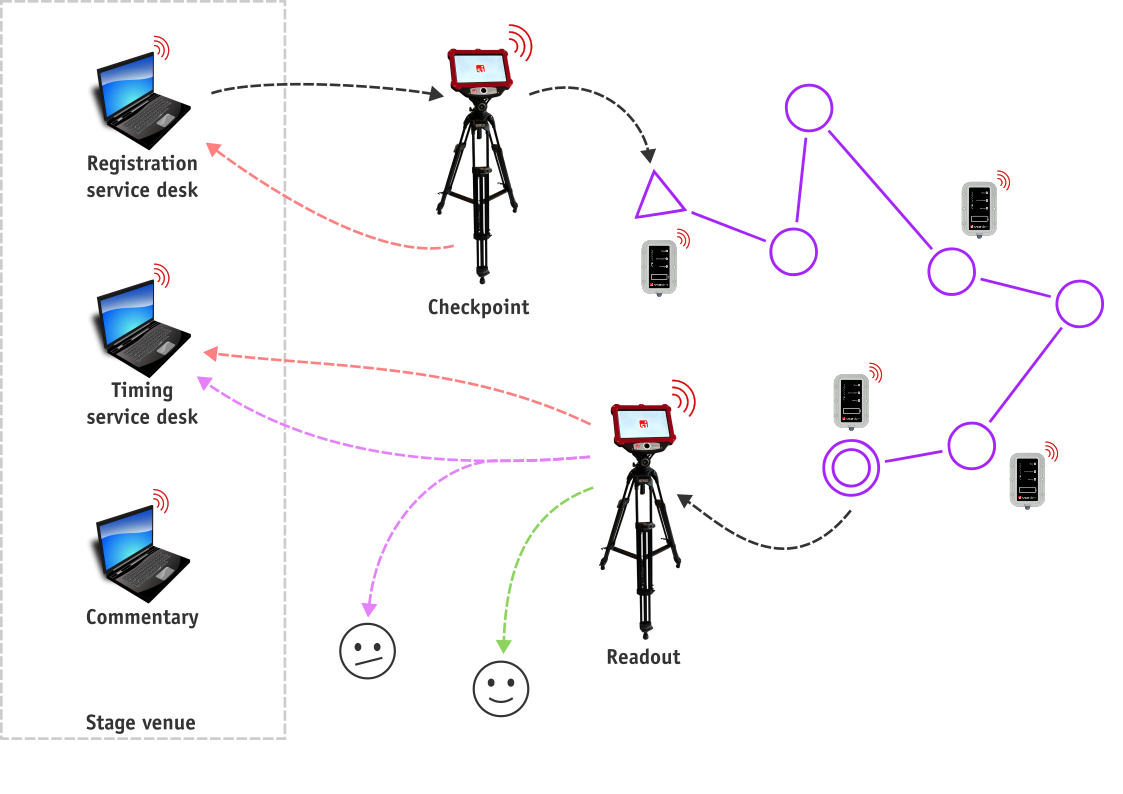
There are seven logical locations related to the timing solution: (1) the registration service desk for day registrations and entry changes, (2) the checkpoint terminals on the way to the start, (3) the start, (4) the course, (5) the readout terminals after the finish, (6) the commentary booth, and, finally, (7) the timing service desk (together with the timing back office) for any issues such as wrong categories, start times, etc.
While the two service desks and the commentary booth are at the stage venue and the checkpoint is close to the stage venue, all locations are sufficiently far apart that neither cabling nor Wi-Fi are viable options, at least not at all stages. Therefore, all timing locations are connected to the mobile network or via Starlink. The LTE Modems, terminals, start tablets, and start clocks are all battery-powered and thus need no infrastructure set up at all. The service desks and commentary booth do have power and are under a tent or inside a building.
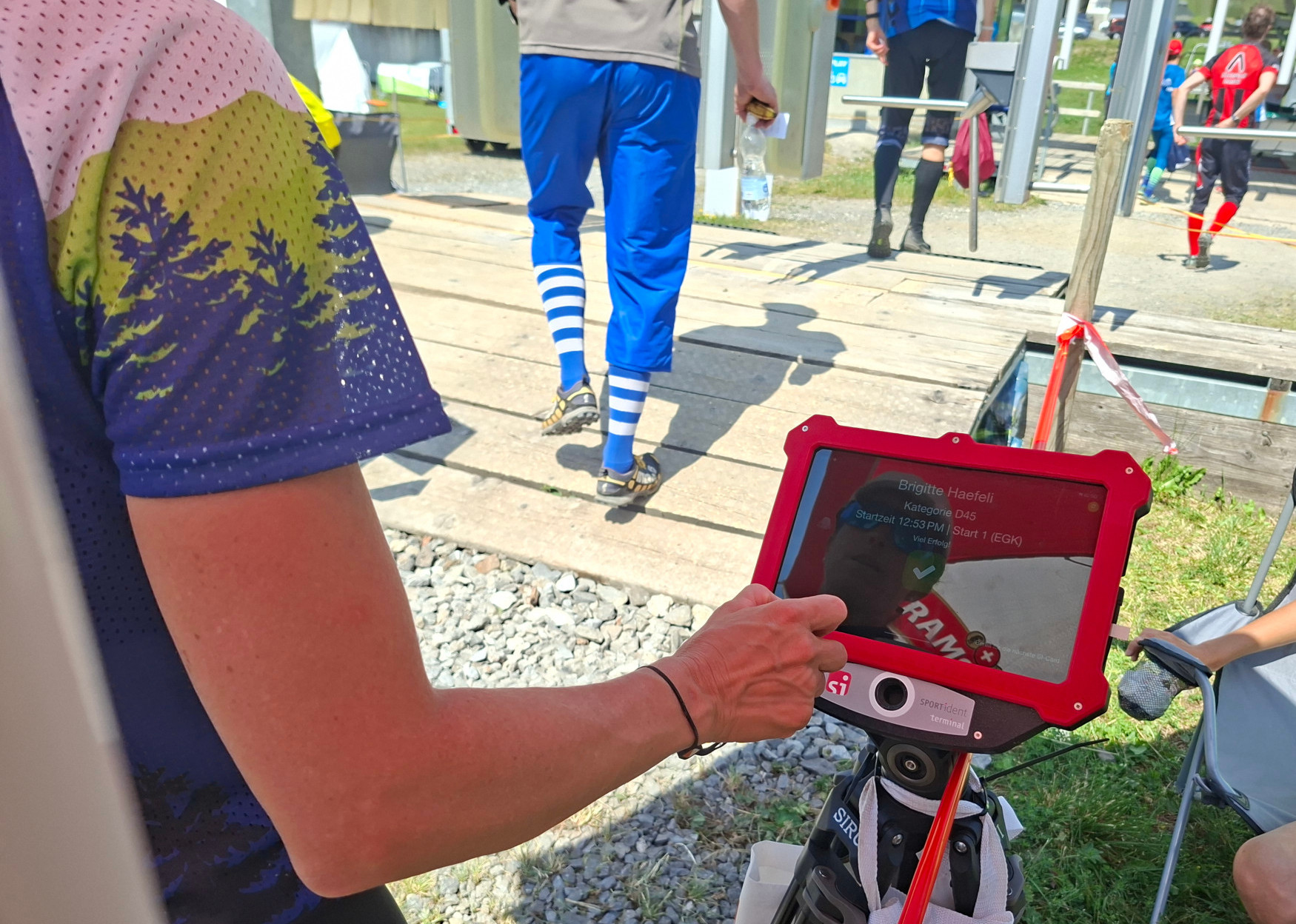
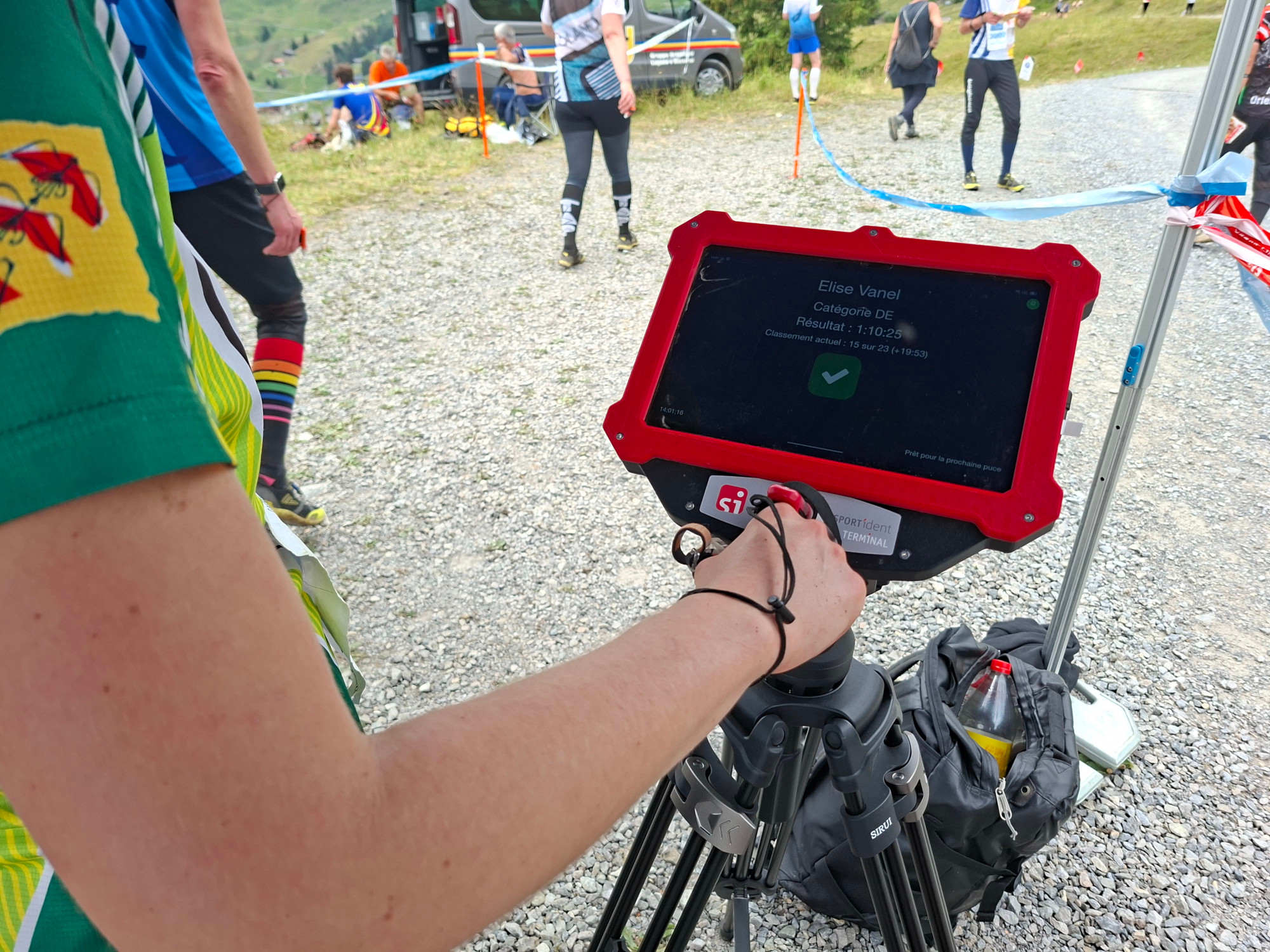
Let’s follow the competitor through the race: He or she leaves the stage venue and passes the checkpoint (one or two different checkpoint locations). The checkpoint terminal ensures that he or she is using an SI-Card known to the system. It shows the athlete’s name, category, start location, and start time. The checkpoint runs the results software and is online. Therefore, safety monitoring knows which competitors are on the way to the start.
In case of a “red screen” at the checkpoint (e.g. unknown SI-Card), the athlete cannot proceed and has to turn back to the registration service desk. There, corrections (as well as day registrations) are done in Trackmaxx, the entry system, with all changes flowing from Trackmaxx to the results software in real time and automatically.
The terminal consists of an outdoor Android tablet, a tripod, and a 3D-printed housing with an integrated, potted BSM8 (mini Reader) PCB. This provides a robust, weather-proof solution. The weakest point is the USB connection which can be secured with sealing material if needed. Future versions of the terminal will use Reader BT to get rid of the cable connection.
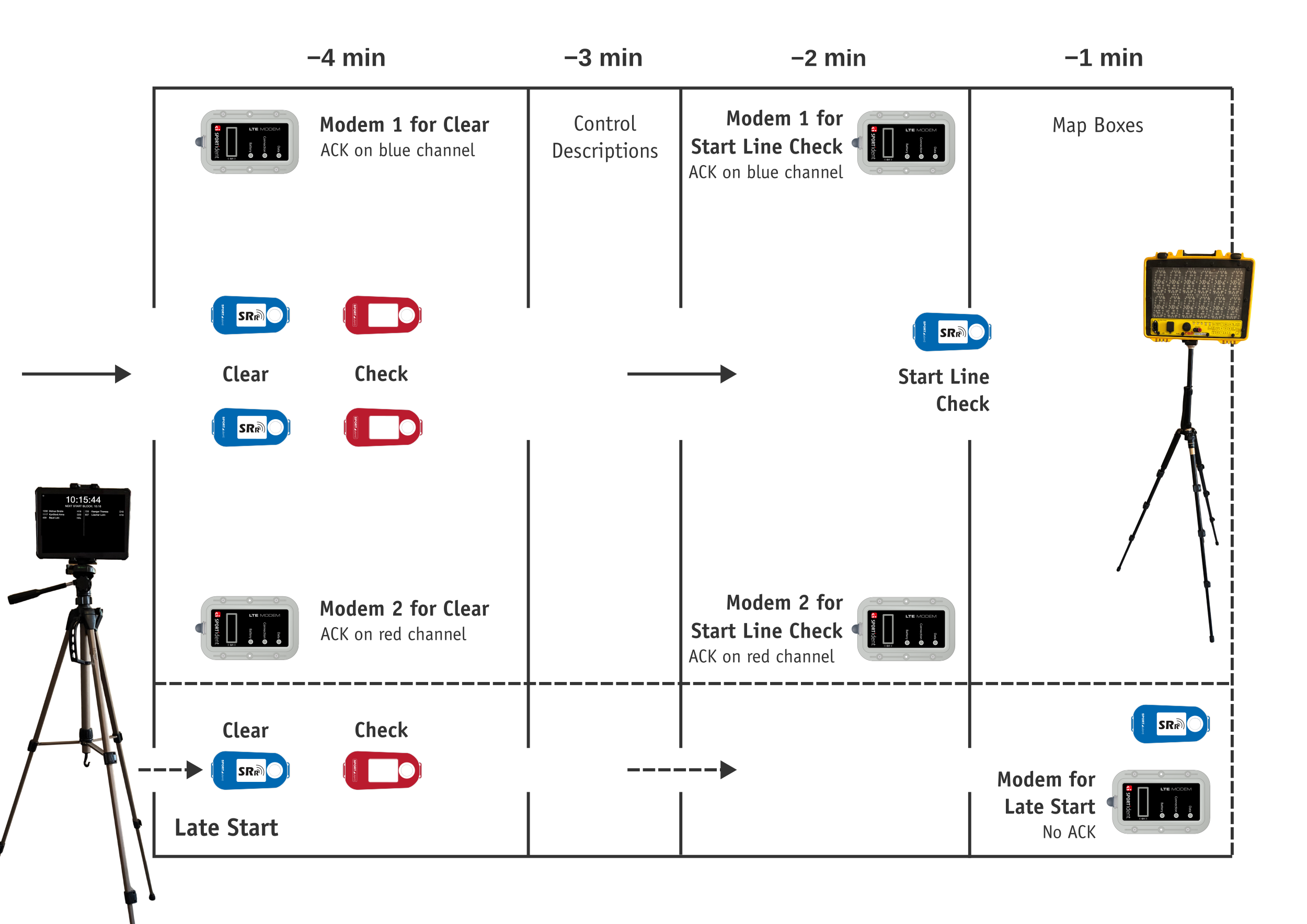
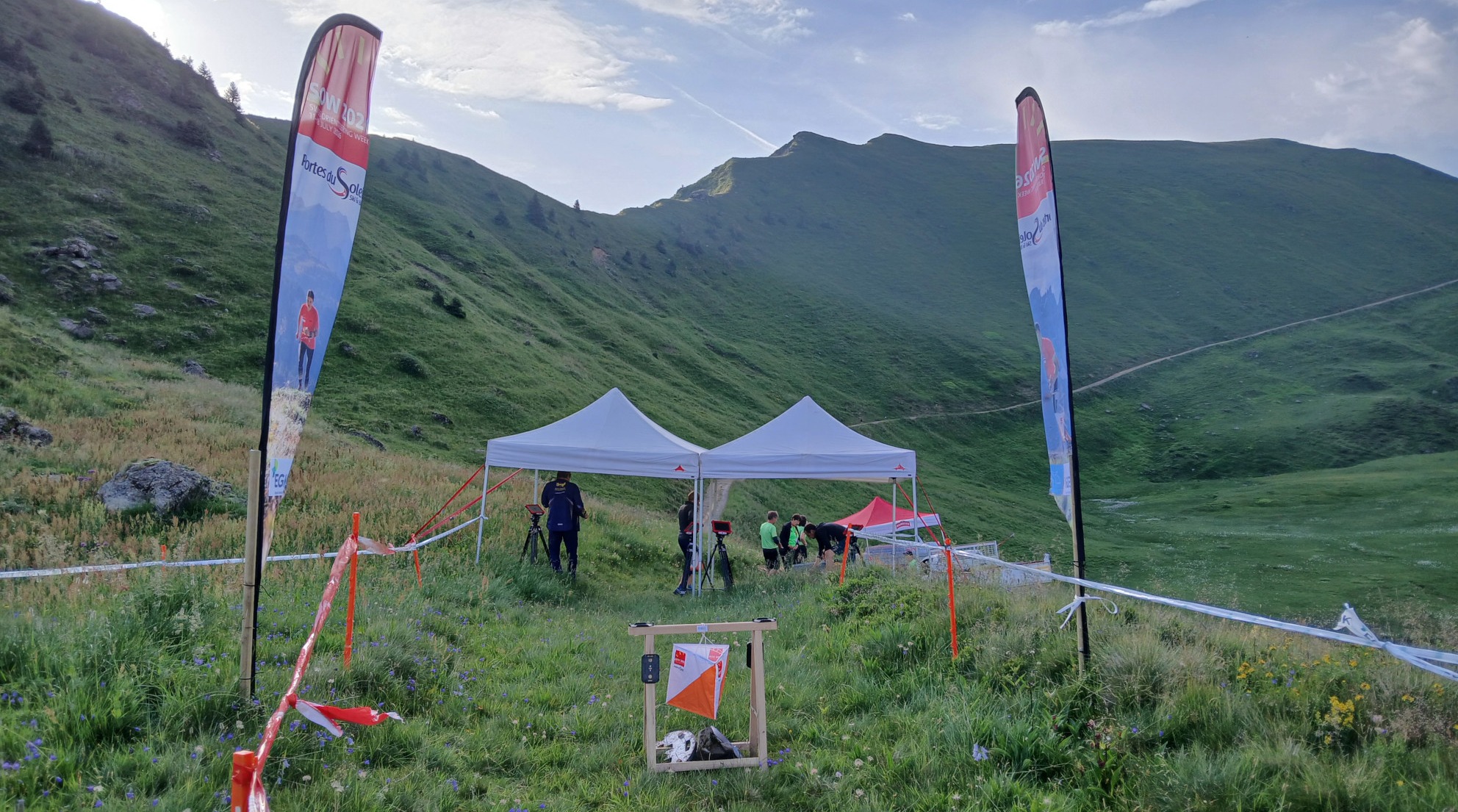
LTE Modems, as any SRR receiver, should be as close as possible to the SRR sender (SRR Station or SIAC), but at most eight meters away. Different SRR receivers should be sufficiently far away from each other in order not to interfere with each other, ideally a distance of 30 meters apart or more. If receivers are closer together, the SRR acknowledgement should be switched off in such a way that there is only exactly one receiver within range that acknowledges on each of the two SRR channels. If there is not any SRR receiver acknowledging then SRR senders will send repeatedly, reducing the overall SRR throughput you can achieve.
So in our case for the start setup this means that we have: At the Clear Stations one modem acknowledging on the blue SRR channel (and not on the red channel), the second modem acknowledging on the red SRR channel (and not on the blue channel). At the Start Line Check Station (which is about 20 meters from Clear) one modem acknowledging on the blue SRR channel, the second modem acknowledging on the red SRR channel. And, finally, a modem at the late start punch start station not acknowledging on any channel, as it is typically (but not necessarily) within range of the Start Line Check Modems.
Using two and more SRR receivers with acknowledgement switched off selectively is an advanced, expert use case that helps increase the overall robustness and reliability (e.g. if a modem dies and, to a limited extent, when it goes offline). The ability to disable SRR acknowledgement is a recent addition to the LTE Modem firmware; it is also available as a configuration option for the SRR USB Dongle.
At the Swiss O Week we had between eight and 20 LTE Modems on the course, enabling more enthralling commentary and giving better insights for safety related concerns. The LTE Modems are simple to use and robust. Using the machine-to-machine technologies LTE-M and NB-IoT, the modems generally provide good connectivity even in low-signal areas and in crowded mobile network cells. Some of the modems had to be charged from day to day, and three hours of charging was enough to get them through eight hours the next day. We probably could have used them two or even three days in a row (eight hours each day) on a full charge. Overall we lost less than 0.5% of punches over SRR and modems (including start and finish modems) which is reasonable given that modem locations were not checked and optimised before each race.
The four readout terminals were placed about ten to 20 meters after the finish. This ensures that all athletes pass readout, even when the finish is remote. The readout terminals run the results software and are online, which means that results are available immediately. From a safety perspective, athletes that have passed readout are considered back from the course and safe. The terminal shows a green screen for a successful run, a red screen if the card is not assigned and a violet screen for missing punches or an incorrect start time. With a red screen the athlete has to go to the timing service desk. With a violet screen the athlete can decide whether to go to the timing service desk, e.g. if he or she believes the MP is not correct. As a nice touch, the terminals show all information in the athlete’s native language (English, French, Italian or German).
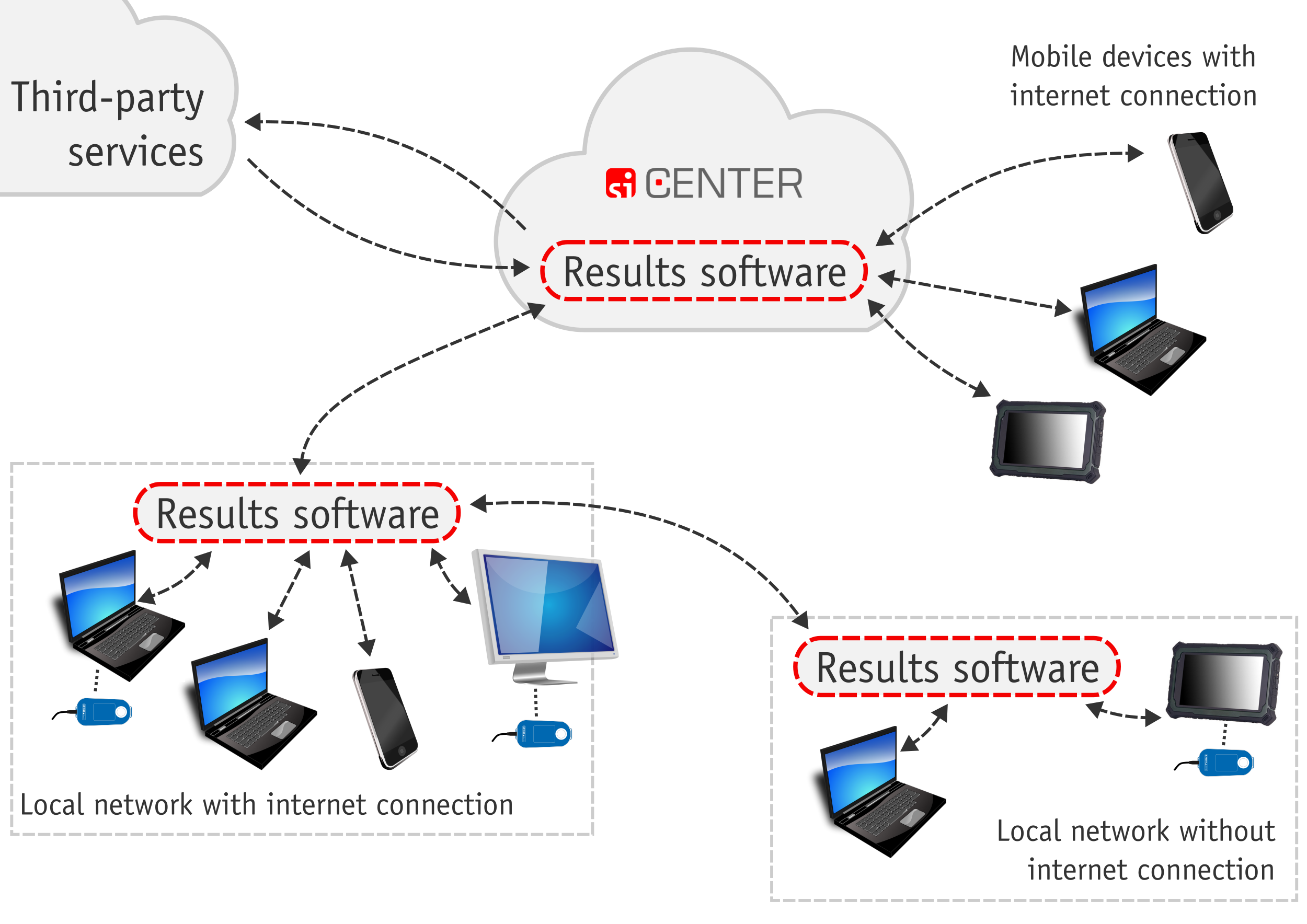
The results software is the foundation of our timing solution at the Swiss O Week. We’ve been building this software over the last four years. As a web app, it stands on a modern tech stack (.NET, Blazor) and currently runs on Windows, Android, Linux, on laptops, tablets, phones and in the cloud. It does not require an external database, making setup and deployment easy. The data synchronisation between different instances of the application is remarkably robust - therefore, even longer connection interruptions are not an issue. Because it is a web application, we can use any device with a browser to work on the event. We need a locally running instance for hardware access, e.g. SI-Card readout and printing.
For the Swiss O Week we had the main instance running in the cloud, with a secondary read-only cloud instance running at a different cloud provider for reliability and failover. All instances on the ground (terminals, timing back office, commentary) were directly connected to the cloud instance, making the local setup very straightforward. The results software integrates with SPORTident Center for modem live punches and with Trackmaxx for entries and results.
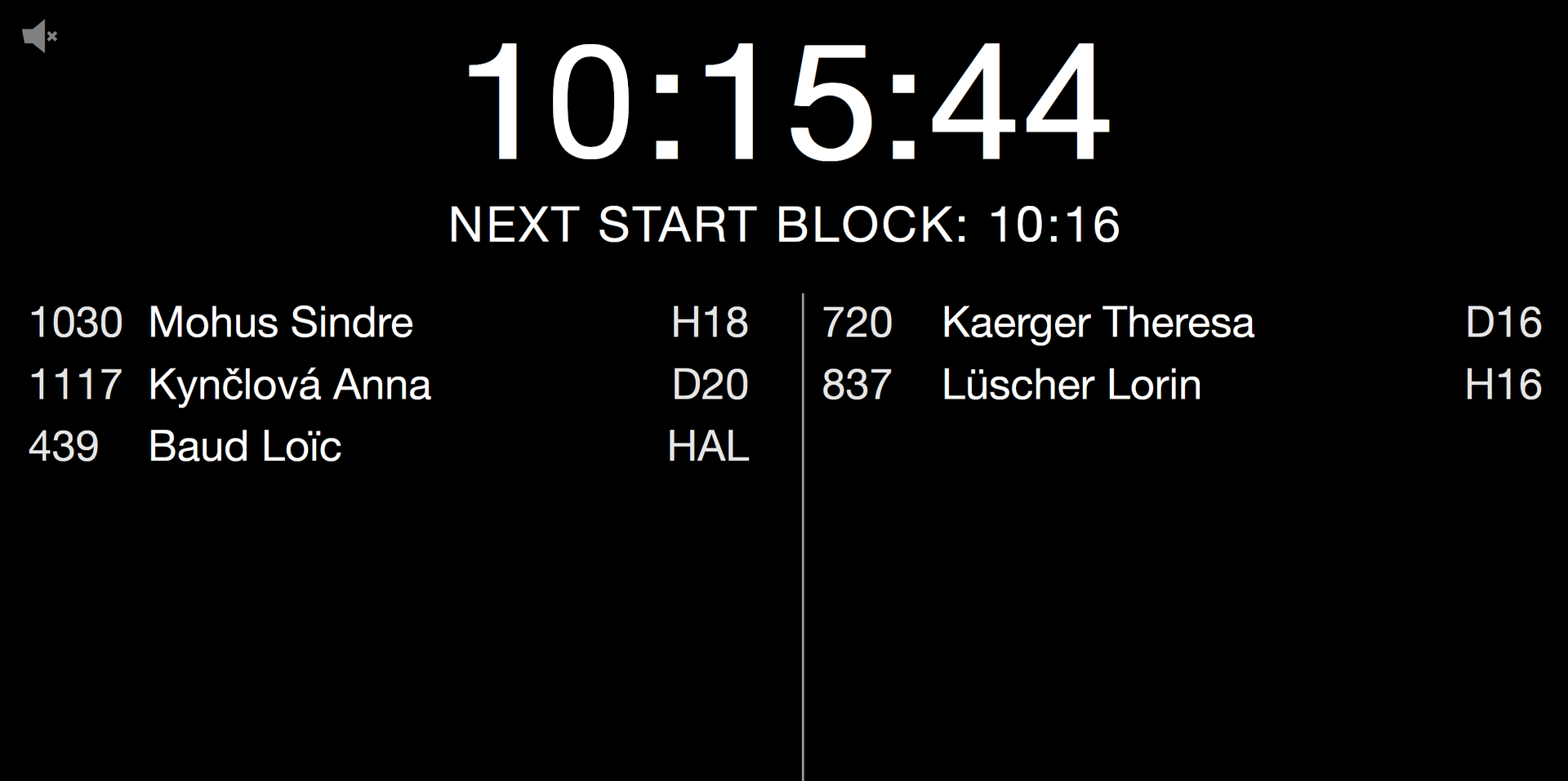
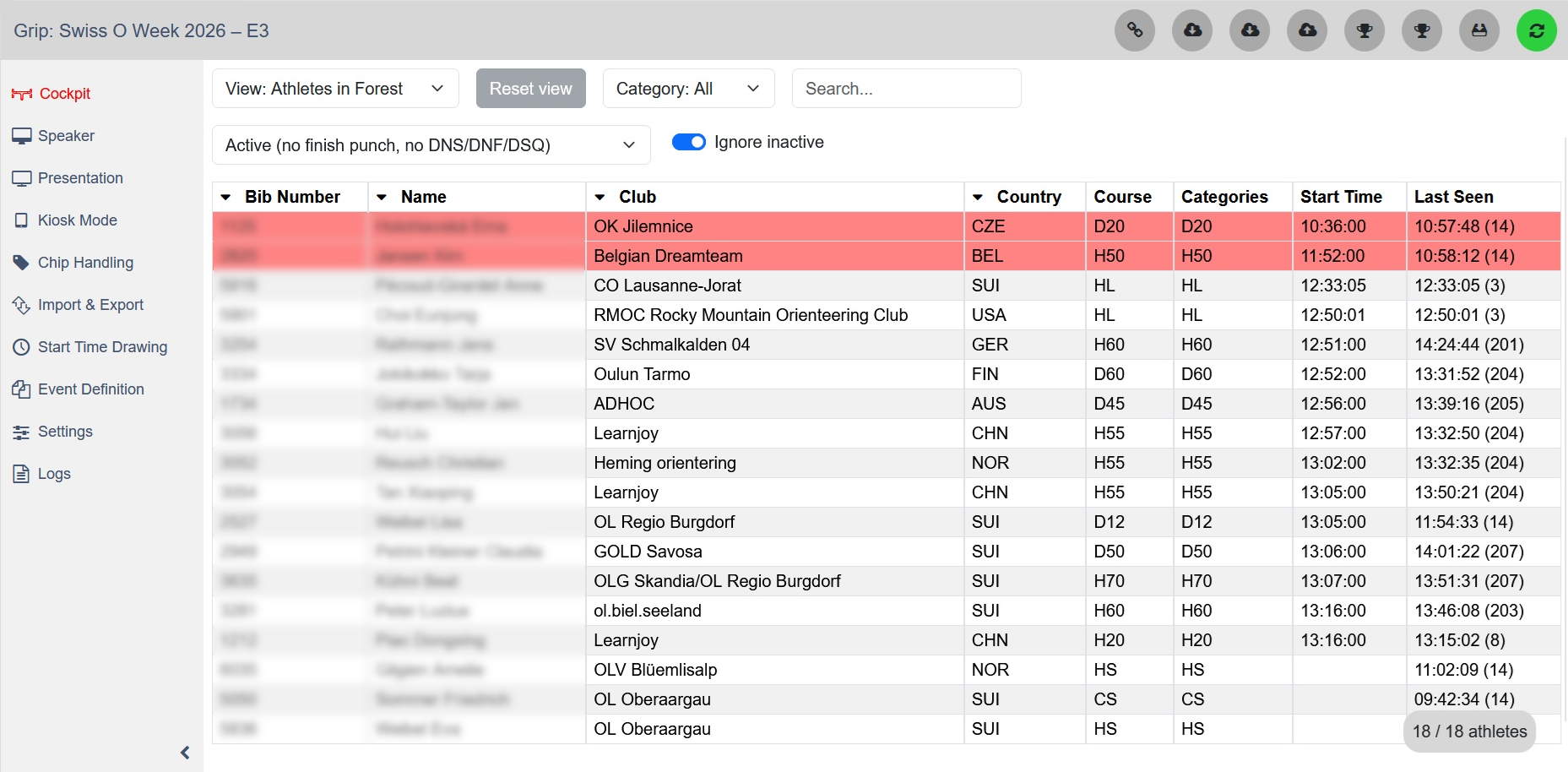
Specifically for the Swiss O Week we focused on start list creation (which is very complex, and an interesting technical optimisation problem), terminal kiosk mode, safety screens and the commentary experience. For safety monitoring, the software shows where each athlete has last been “seen”. Maybe most importantly, it shows how long athletes have been in the forest and flags anyone who has gone over the allowed maximum time. Having this information in real time (and not only after the race) and in an easily understood and actionable view was a key improvement for the safety monitoring team.
Let’s look at some of the different views provided by the software.
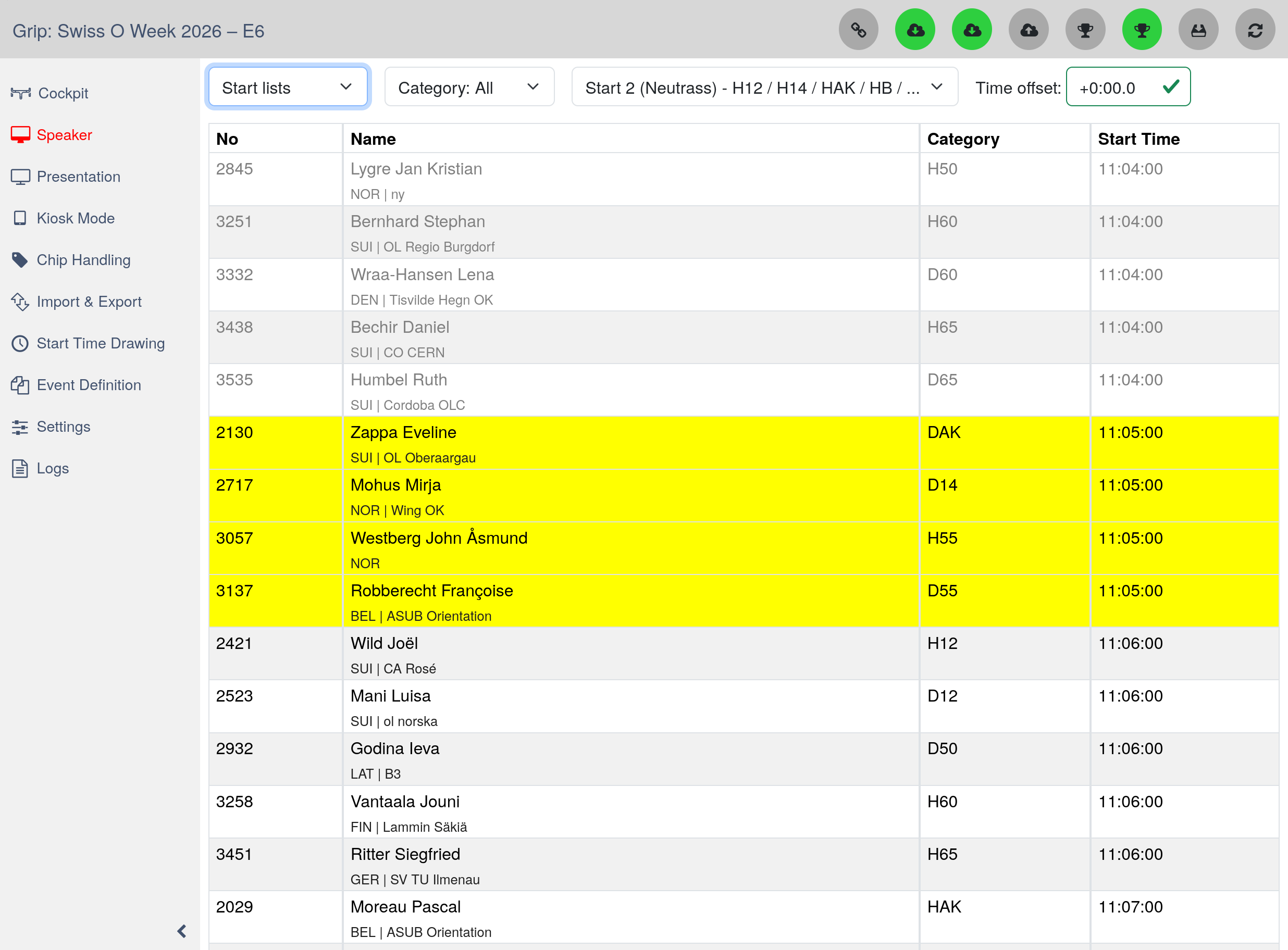
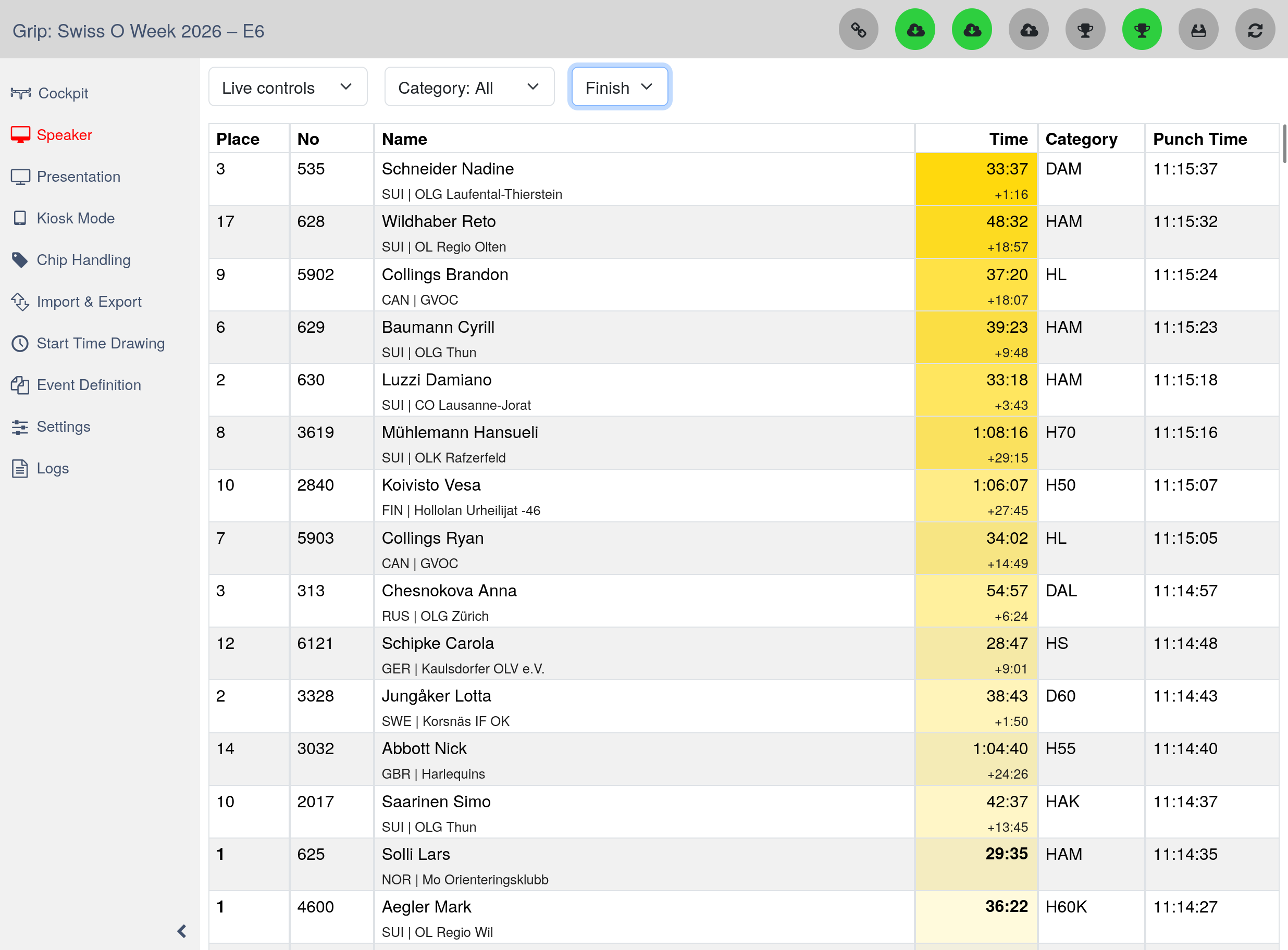
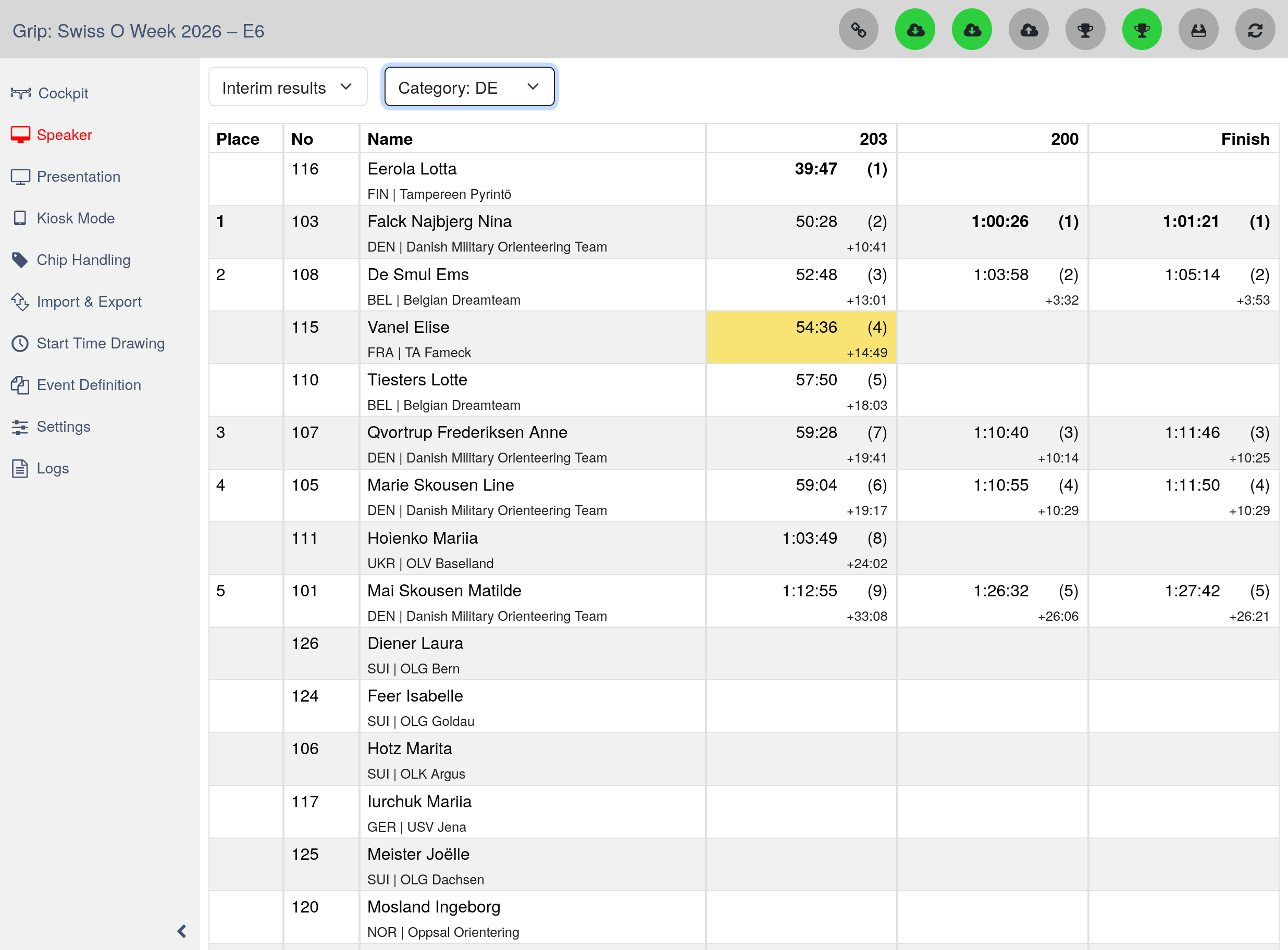
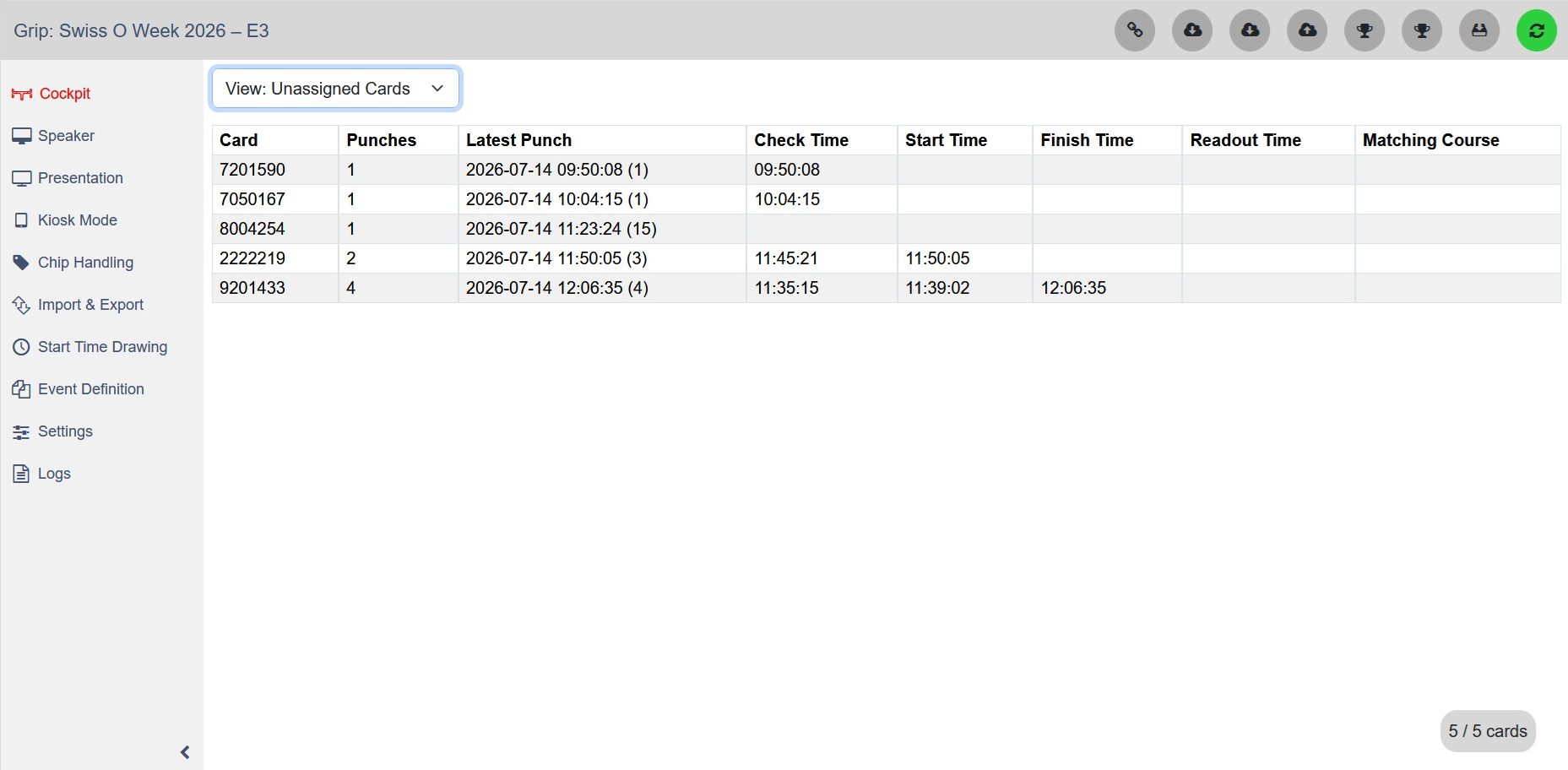
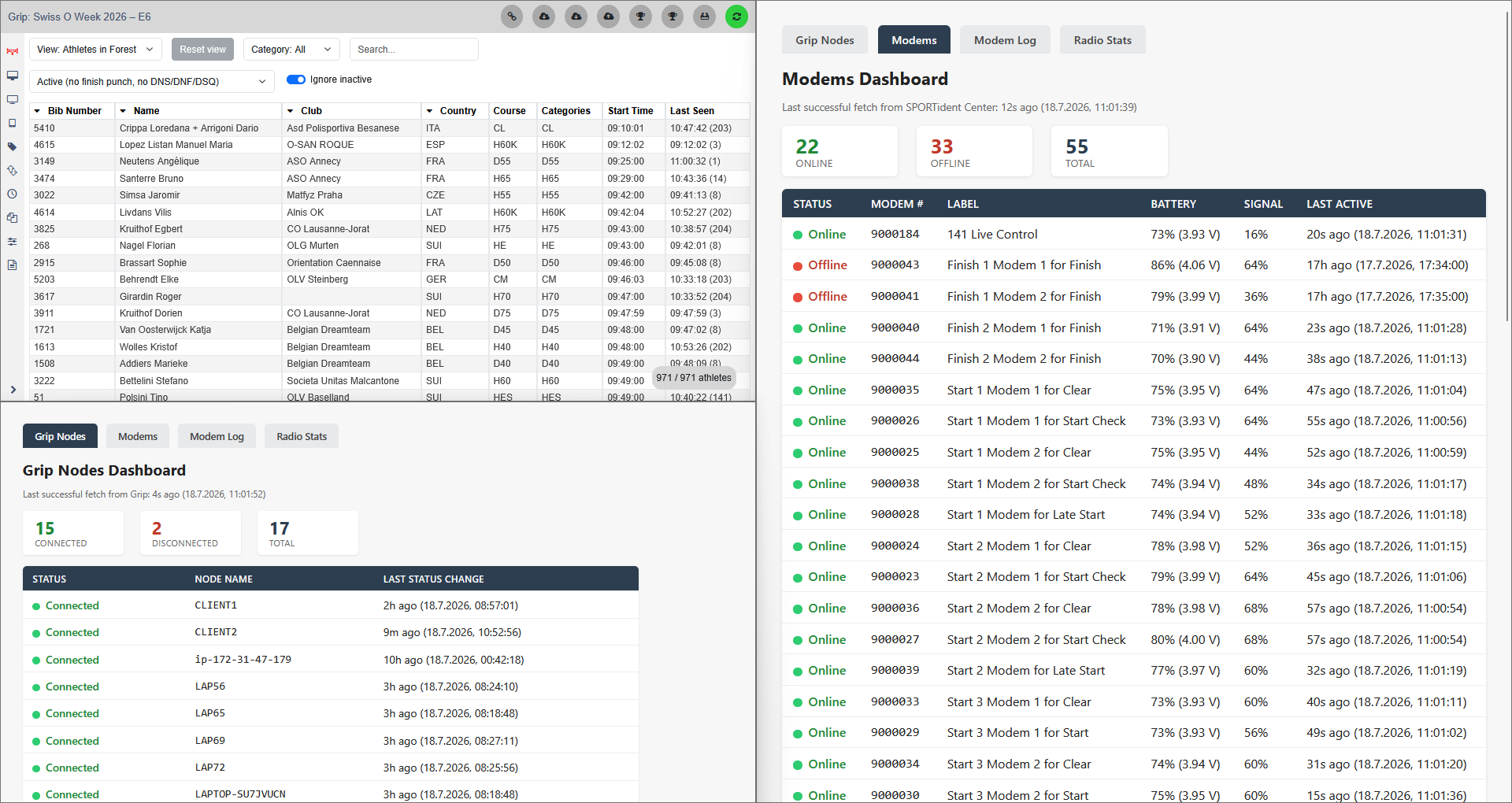
Like pretty much everybody we’ve been using AI coding agents for our development work more and more over the last months and years. The effectiveness of AI agents differs by task and harness, but it is particularly easy to have them create one-off scripts or apps of limited scope and complexity.
We created a monitoring dashboard specifically for our timing needs at the Swiss O Week within about three working hours, simply by pointing the agent at some (partly internal) API endpoints of our results software and of Center, giving it a number of instructions, going through a few iterations. The dashboard covers monitoring for the modems and results software instances and also provides modem and SRR transmission statistics. We’ve used it as our primary monitoring screen, together with a few screens from our results software, throughout the Swiss O Week.
We believe that this could be a pointer towards the future of timing solutions. Interconnectivity and APIs become more important. You would have your agent build the exact monitoring setup that makes sense for your specific event and throw it away after the race. Obviously, this approach could also expand beyond monitoring and cover, potentially, custom results computation and other use cases.
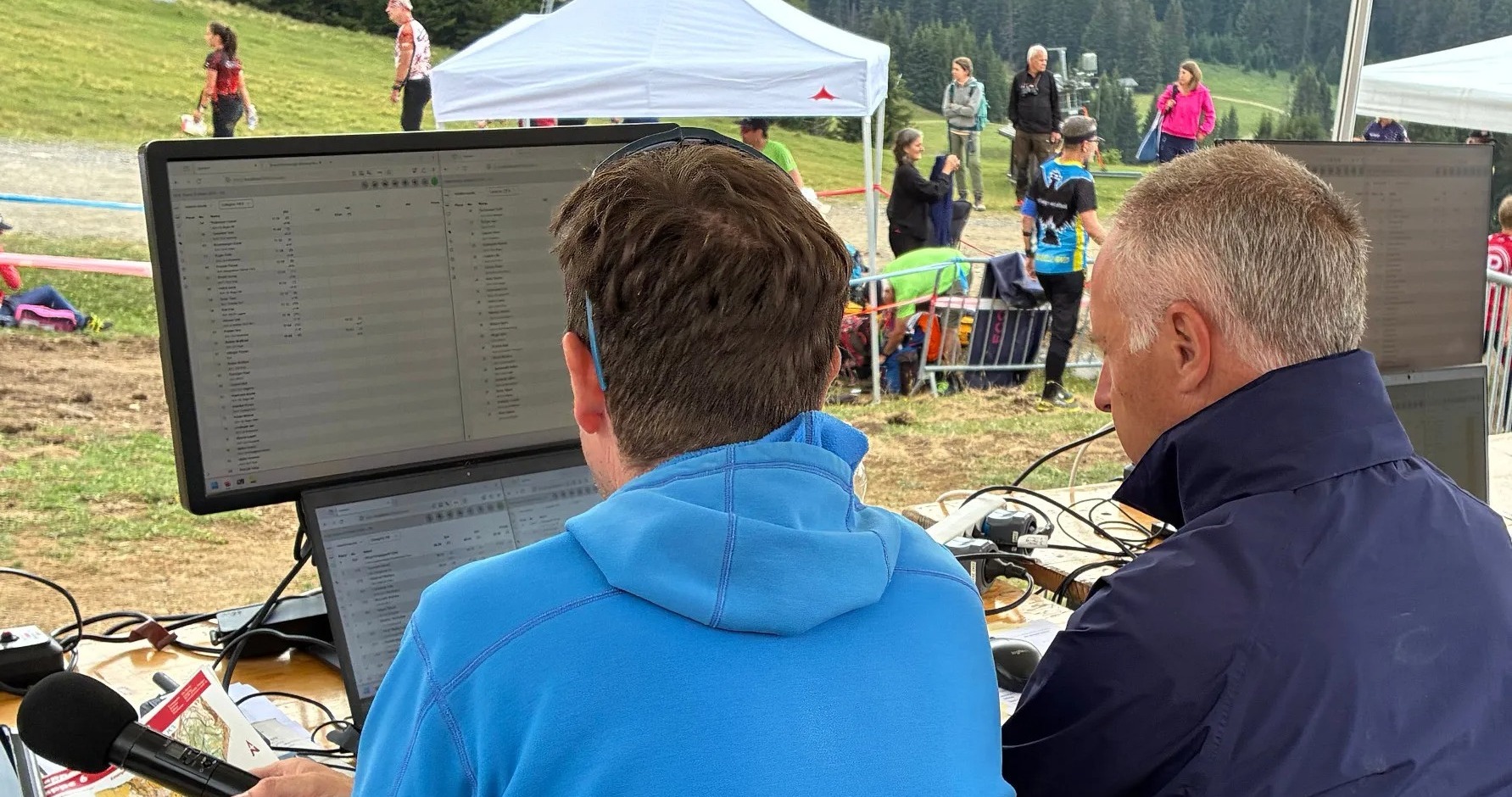
Timing the Swiss O Week was a success. We had virtually no issues. Operating the system was very smooth. The checkpoint and readout terminals ensured a smooth flow of competitors. The organisers knew at all times where all athletes were and final results were available within a second of readout. Commentary had good insight into live results and provided an enthralling experience for the runners and audience in the arena.
The simplicity of the infrastructure and setup made a difference for us as the timekeeping team. We had no network cabling, everything running on Wi-Fi and directly connected to the main results software instance in the cloud. However, the daily preparation work for the next stage is still significant and there is some room for improvement, for example regarding the (currently manual) configuration of the tablets. Charging time for tablets and modems is critical. The amount of equipment and materials is also very significant and thought will go into how this can be reduced in the future.
The checkpoint and readout terminals were operated by a sufficient number of volunteers. As the self-service terminals become more established and see a few more tweaks, it will be feasible to staff each checkpoint location with only one volunteer and each readout location with only one or two. We will also consider terminals for the start in the future. A self-service solution there can provide even more confidence for safety monitoring and ease the workload of the volunteers at the start.
It is worth noting that our setup requires good mobile connectivity pretty much everywhere. All venues at the Swiss O Week 2026 were in skiing areas and mobile coverage was excellent. In areas with less coverage, long-range Wi-Fi networks can be part of the solution as can − depending on the budget − the use of maybe two or three Starlink Mini Kits that you’d need to lug around with portable power stations (a.k.a. big powerbanks).
Lastly, with the results software running in the cloud, remote support options should become viable in the future, where a part of the timing team is no longer on-site. But, of course, you still need to be in the mountains if you want to participate in the breathtaking orienteering experience that is the Swiss O Week.
The next version of the SPORTident Orienteering App, coming later this year, will be based on the same results software used at the Swiss O Week. In addition to a range of small improvements and fixes, this will bring Windows support, Emit hardware support and live data integration to our app for trainings and small events. It will be the foundation for more notable features in the future, such as multi-device capabilities and interoperability with the “full” results software. We do not yet have a timeline for when the “full” results software will become available to all of our users. We expect that we will look for early testers and adopters next year.
The terminals are quite different from other equipment we are currently producing. We are considering making them available for rental in the future. Please let us know if you are interested in the terminals and how you would want to use them. This will help us to decide what’s the best way forward with the terminals.
If you have any comments or questions regarding timing at the Swiss O Week in general and also specifically about any of the components used or technical details touched upon, please write to us at support@sportident.com. Thanks for reading!